The Rs 1,500 crore prompt: How Google and OpenAI bought into Indian cricket
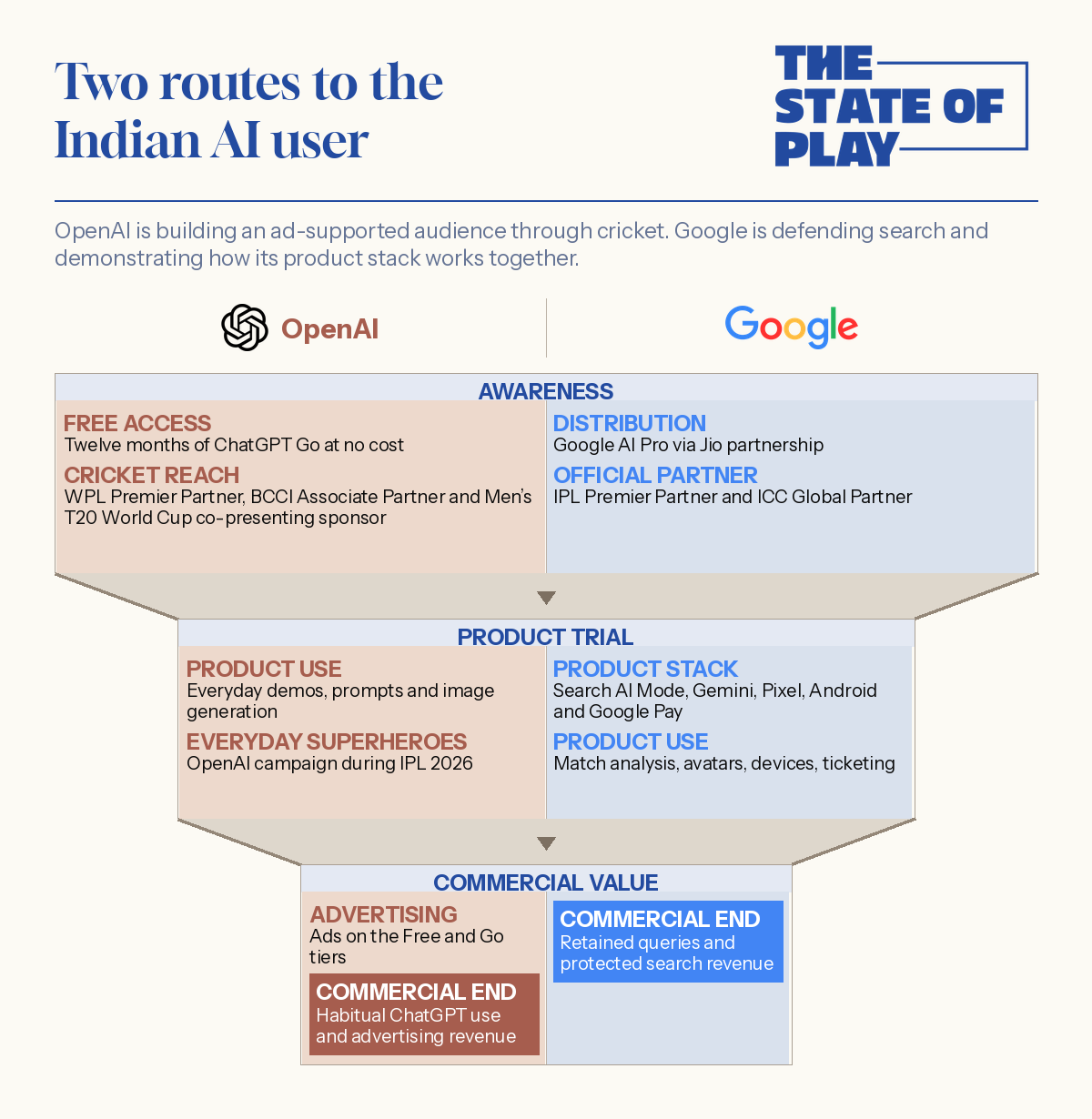
As gaming money receded, Google and OpenAI turned to cricket with rights, partnerships, and media packages valued at nearly Rs 1,500 crore. Both want their products to become the first place Indians turn to when a question comes to mind.

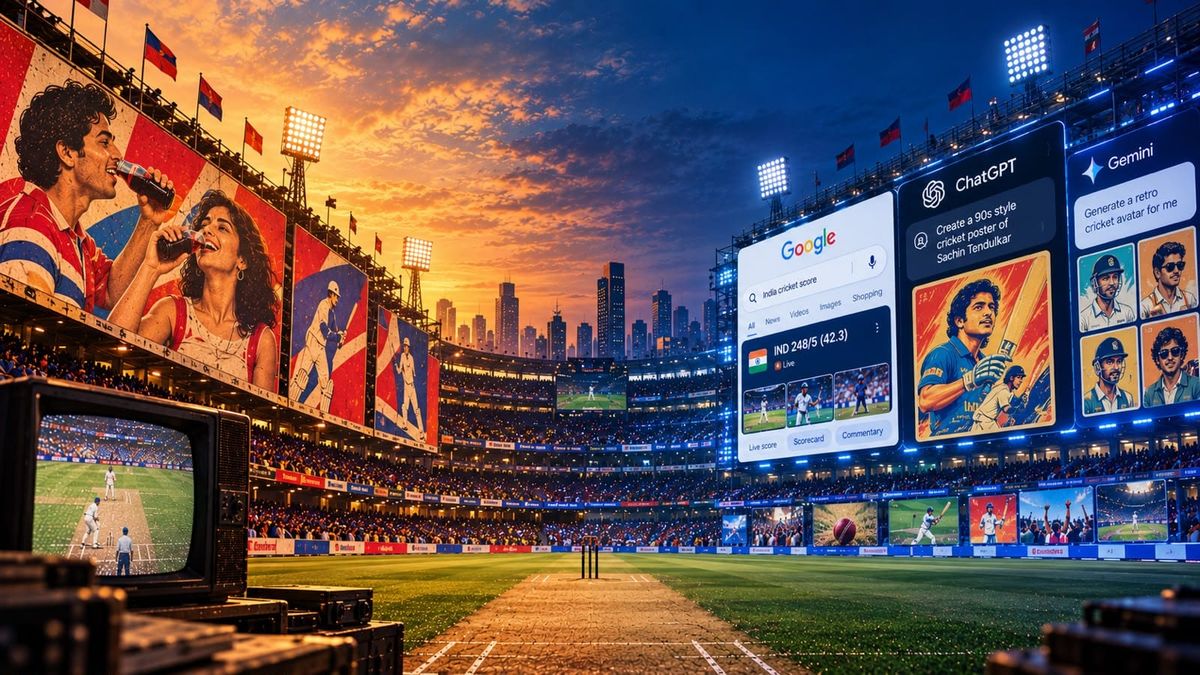
In 1996, Coca-Cola paid a reported Rs 10 crore to become the official drink of the Wills World Cup. Pepsi lost the bid, only to counter with Sachin Tendulkar, a conspiratorial wink, and four words that followed a generation from school corridors into adulthood: Nothing Official About It.
The cola rivalry soon spread across cricket’s calendar. Pepsi lent its name to 17 tournaments between 1993 and 2007. Coca-Cola sponsored ten between 1998 and 2001. In April 1998, the Pepsi Cup final in Delhi and the Coca-Cola Cup final in Sharjah were separated by ten days. It was in Sharjah that Tendulkar compiled back-to-back hundreds against Australia (the second on his 25th birthday) to seal the Coca-Cola Cup.
Thirty years later, ChatGPT had ten questions to identify the man speaking to it. The answer, once again, was Tendulkar.
On September 28, OpenAI named the 53-year-old as a multi-year partner for ChatGPT in India. The announcement came twenty days after ChatGPT became an Associate Partner of the Board of Control for Cricket in India (BCCI) for 35 India home matches through March 2028. The BCCI deal is reportedly worth Rs 1.2 crore per match, or Rs 42 crore in total.
OpenAI was already a Premier Partner of the Women’s Premier League (WPL) and had deals with five IPL franchises during this year’s tournament. The precise term and value of Tendulkar’s agreement private. People familiar with celebrity endorsement fees put it at Rs 5-8 crore a year.
The State of Play estimates that the combined value of Google and OpenAI’s cricket rights, partnerships and advertising in India approached Rs 1,500 crore, or about $156 million, in the thirteen months since Google signed its first agreement with the International Cricket Council (ICC).
“This is a serious category,” said Shiv Burman, founder of sports marketing agency Burman Sports. He sees AI as a natural part of fans’ lives and expects companies to spend the next three to five years building awareness and shaping user behaviour.
When gaming money left
Google and OpenAI entered cricket as some of the sport’s largest real-money gaming sponsorships were unwinding. They bought a different mix of rights, partnerships and advertising.
India’s Parliament passed the Promotion and Regulation of Online Gaming Act on August 21, 2025, and presidential assent followed the next day. Google signed its first agreement with the ICC a week later.
By the time the ban took effect on May 1, 2026, Dream11’s Rs 358 crore, three-year agreement for the India jersey had ended. Apollo Tyres had taken over the shirt for Rs 579 crore through March 2028. My11Circle had also lost an IPL partnership worth a reported Rs 125 crore a year.
At the same time, Google and OpenAI were building large Indian user bases. Sensor Tower counted 180 million monthly active ChatGPT users in January 2026, compared with 118 million for Gemini and 12 million for Meta AI.
The audience numbers hid a wide revenue gap. Sensor Tower recorded 18.1 million Gemini downloads in India during the second quarter of 2026, against Rs 1.8 crore in in-app purchase revenue.
Adoption was already deep. BCG’s 2026 survey found that 95% of Indian frontline employees used AI every day or several times a week, compared with a global average of 74% across the 14 markets it surveyed.
OpenAI’s 2026 usage report found that coding questions from India were nearly three times the global median and education questions nearly twice the median. About 35% of non-work messages sought practical guidance. Google identifies simplifying complex information, how-to instructions, writing and creative ideas among Gemini’s leading applications in India.