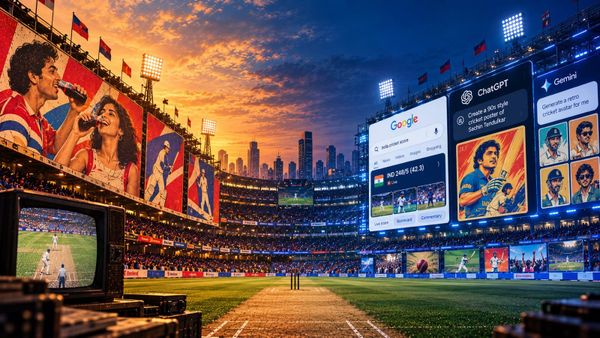
From S Tendehar to the ICC: Cricket’s 43-year hunt for a game of its own
For nearly four decades, cricket has chased a digital mirror worthy of its devotion. Time and again, it has come close, only to misplace the moment. Now, the ICC believes it has finally assembled the pieces. Turning those pieces into one complete game will be harder.


In 1983, a small London publisher, CRL Group, slipped Test Match Cricket onto the Sinclair ZX Spectrum: stick figures, a button to bowl, another to steal a single, the barest sketch of a sport. A full decade before FIFA International Soccer took shape, before Madden learned how to sell Sundays back to America, cricket already lived inside a screen. It came early, blinking into the future.
It then spent four decades failing to make the most of that head start.
If you grew up in India in the 1990s or early 2000s, you remember what cricket gaming felt like at its best, and at its most maddening.
You remember Codemasters’ Brian Lara Cricket on a pirated CD, the loading screen stretching on longer than a rain delay that wouldn’t clear. You remember International Cricket Captain, where you could run a county into the ground (my pick: Middlesex or Somerset) across three simulated seasons on a school night and feel oddly proud of the wreckage.
You remember the exact grain of Richie Benaud’s voice in EA Cricket—measured, unhurried—calling a shot “magnificently played” for the fourteenth time in an over. And if you were any kind of serious player, you remember the cheat code (131!) that turned every ball into a six and you into something close to immortal, letting you beat Australia by an innings in a Test match the BCCI had refused to licence. Phew.
The bargain was that the players looked familiar but could not be called by their names.
EA Sports kept its cricket series alive for more than a decade. Cricket 96 landed on MS-DOS while licensed player names were still a novelty in sports games. Cricket 97 followed, then a procession of early-2000s titles, solid, sometimes inspired, but never solving the problem that mattered most.
The games sold well enough in England and Australia. In India, already becoming cricket’s richest market, piracy ate through the margins while the BCCI withheld what players wanted most: properly licensed Indian names.
By 2006, Cricket 07 was as close as EA came—and even then, Sachin Tendulkar appeared as S Tendehar, Sourav Ganguly as S Gungly, every Indian player a flickering ghost of himself: familiar in face and stature, erased in ink.
The following year, EA walked away. Codemasters lasted until 2010. Cricket had beaten football to the screen by a decade and still failed to build a game worthy of the people who loved it most.
Now the International Cricket Council is trying to rewrite that story. The ICC did not respond to The State of Play's detailed questions.